

BrainVoyager Plugins for Windows
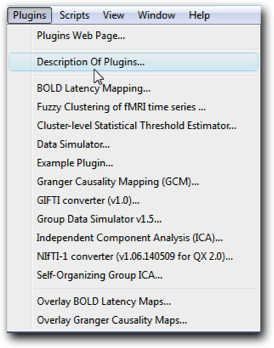
Support for plugins constitutes an important feature of BrainVoyager allowing to extent the software with additional computational routines. These extensions can be created by anyone able to write C++ code without the need for an update of BrainVoyager. When BrainVoyager is installed on your computer, you will find several supported plugins, most of which developed by Brain Innovation. All plugins are accessible through the "Plugins" menu (see figure on the right) after installation. The table below lists the most recent versions of these plugins. Additional plugins not listed below or not distributed with the standard BrainVoyager installation can be found at the Support Web Site.Consult the "Plugins" topic in the "Additional Documentation" chapter of the User's Guide for further details on how to use plugins. If you have yourself created a plugin and think about sharing it with BrainVoyager users around the world, send an email to "support_at_brainvoyager_dot_com". Note that the plugins provided by Brain Innovation and Maastricht University are automatically installed with BrainVoyager. If you have a recent version of BrainVoyager installed, you usually do not need to download plugins.
Multiple users. If you do not find plugins in the "Plugins" menu, it is likely that you are not logged in as the user who installed BrainVoyager since plugins are stored in the "Documents\BVExtensions" folder during installation. In that case we recommend to install the whole "BVExtensions" folder that includes all standard plugins as well as scripts and plugins (see below).
Note. Since BrainVoyager 20, plugins can also be developed in Python. Python scripts and plugins are available through the "Python" icon in the main toolbar or via the "Python" menu.
Download and Installation
It is recommended to download the contents of the whole "BVExtensions" folder containing all plugins as well as JavaScript and Python scripts:| BVExtensions_Win64_v21.zip |  |
Extract the downloaded "BVExtensions_Win64_v21.zip" file in the Documents folder so that the unzipped contents is stored in the user's "Documents/BVExtensions" folder. If the data is extracted at another location, move the "BVExtensions" folder into the "Documents" folder. The "BVExtensions" folder will contain the "Plugins_64", "Scripts", "PythonScripts" and "PythonPlugins" subfolders.
If you want to (re-)download specific plugins, select the plugin using the respective link in the table below and put it into the "Plugins_64" folder. The "Plugins_64" folder is located within the "BVExtensions" directory, which is itself located within your "Documents" folder. Extract the plugin zip file using Windows Explorer or any other "unzip" tool.
Getting Help for Plugins
Most plugins contain help files, which are extracted in sub-folders within the "Plugins_64" folder. The available documentation of a plugin can be accessed by clicking a respective link in the plugins overview text, which you get by clicking the "Description Of Plugins" item in the "Plugins" menu (see snapshot above). The help for the ICA plugins can be found in the User's Guide.| Plugin Name | Author | Description | Download |
|---|---|---|---|
| Example Plugin | Rainer Goebel Brain Innovation |
Simple plugin inverting intensity values of a VMR. It can be used by developers to get started with plugin development (see menu "For Developers" for source code) | ExamplePlugin_Win64.zip |
| Example GUI Plugin | Rainer Goebel Brain Innovation |
Simple GUI plugin providing functions to process VMR intensity data. It can be used by developers as a template for own GUI plugin development (see section "For Developers" for source code) | ExampleGUIPlugin_Win64.zip |
| Data Simulator | Rainer Goebel Brain Innovation |
Creates simulated volume time course data (VTCs). Realistic example of a plugin that can be used by developers to get started (see section "For Developers" for source code | DataSimulatorPlugin_Win64.zip |
| Group Data Simulator | Rainer Goebel Brain Innovation |
This tool allows to create simulated volume time course (VTC) data, protocols (PRT files) and design matrices (SDM files) for multi-factorial designs with between and within factors. | GroupDataSimulatorPlugin_Win64.zip |
| Independent Component Analysis (ICA) | Federico de Martino, Fabrizio Esposito, Rainer Goebel Brain Innovation |
Indpendent Component Analysis (ICA) for VTC files. Consult the User's Guide for documentation on how to start the ICA plugin via the "Independent Component Analysis" dialog and how to visualize the obtained independent components using the "Overlay Independent Components" dialog. | ICAPlugin_Win64.zip |
| Self-Organizing Group ICA | Fabrizio Esposito Brain Innovation |
Self-organizing group ICA for VTC files. Consult the User's Guide for documentation on how to use the plugin (chapter "Independent Component Analysis"). | SogICAPlugin_Win64.zip |
| Cluster Threshold Estimator | Fabrizio Esposito Brain Innovation |
This plugin provides a method for the correction of multiple comparisons using cluster-size thresholding. | ClusterThreshPlugin_Win64.zip |
| COPE | Joost Mulders, Levin Fritz, Hester Breman Brain Innovation |
This plugin (COPE = Correction based on Opposite Phase Encoding) corrects EPI distortions using reverse phase-encoded data (anterior-posterior (AP/PA) or left-right (LR/RL). | COPEPlugin_v11_Win64.zip |
| Randomise | Marco Mecchia Brain Innovation |
This plugin implements permutation-based non-parametric inference for group-level GLM designs. | RandomizePlugin_Win64.zip |
| PPI | Joost Mulders, Rick van Hoof, Rainer Goebel Brain Innovation |
This plugin creates the regressors needed for Psycho-Physiological Interaction (PPI) analysis. | PPIPlugin_v20_Win64.zip |
| GCM | Alard Roebroeck Maastricht Univ. |
The Granger Causality Mapping (GCM) plugin creates maps of directed influences (effective connectivity). | GCMPlugin_v16_Win64.zip |
| RFX GCM | Alard Roebroeck Maastricht Univ., Rainer Goebel Brain Innovation |
Computes Granger Causality Maps (GCMs) for a reference region (VOI) across data of multiple subjects. A generic VOI may be used for all subjects or subject-specific VOI definitions, e.g. from individual localizer experiments. | RFXGCMPlugin_v25_Win64.zip |
| BOLD Latency Mapping (BLM) | Fabrizio Esposito Brain Innovation |
This plugin allows analysis and mapping of latency parameters of the BOLD response. | BLMPlugin_Win64.zip |
| Fuzzy Clustering | Federico de Martino, Alain Smolders, Rainer Goebel |
This plugin performs a volume-based or cortex-based clustering of the voxels based on their (optionally averaged) time course. | ClusteringPlugin_Win64.zip |
| NIfTI-1 Converter | Hester Breman Brain Innovation |
This plugin converts between BrainVoyager and NIfTI-1 file formats. It is also possible to obtain file header information via the BrainVoyager Log tab, in a text file or in both ways. This plugin is usually installed in the "NIfTI GIFTI Plugins" sub-folder. | nifticonverter_v110_Win64.zip |
| GIFTI Converter | Hester Breman, Joost Mulders Brain Innovation |
This plugin makes it possible to import and export surface files (meshes, timeseries and statistical maps) to GIFTI format. This plugin is usually installed in the "NIfTI GIFTI Plugins" sub-folder. | gifticonverter_v17_Win64.zip |